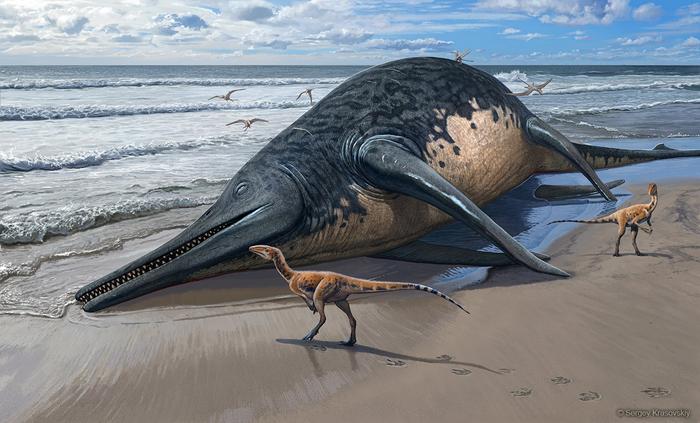
Ichthyotitan: Unearthing the Largest Marine Reptile Known
The depths of the Triassic Period's oceans held secrets for millions of years, until recently, a monumental discovery surfaced from the ancient mudstones of England. Paleontologists and fossil enthusiasts alike are now marveling at
Ichthyotitan, an awe-inspiring marine reptile that has claimed the title of the largest known to science. This colossal ichthyosaur, with an estimated body length approaching an astounding 25 meters (82 feet), not only redefines our understanding of prehistoric marine megafauna but also offers crucial insights into the health of marine ecosystems just before one of Earth’s most significant extinction events.
Found nestled within the Westbury Mudstone Formation in Somerset, England, *Ichthyotitan* is more than just a giant; it's a testament to the enduring power and diversity of life in the Triassic seas. Its discovery has illuminated the fascinating story of shastasaurids, a family of ichthyosaurs that were thriving right up until their abrupt disappearance during the Triassic-Jurassic extinction.
Unveiling the Colossus: What Makes Ichthyotitan So Remarkable?
At the heart of *Ichthyotitan*'s significance lies its sheer, unimaginable size. With estimates suggesting a length of nearly 25 meters, this makes it comfortably the largest marine reptile ever identified. To put this into perspective, *Ichthyotitan* would have been longer than a modern blue whale and significantly larger than previously known giant ichthyosaurs like *Shonisaurus sikanniensis*, which reached around 21 meters (70 feet). Imagine a creature the length of two standard city buses, swimming through ancient oceans!
This leviathan belongs to the shastasaurid family, a group of ichthyosaurs known for their often enormous, whale-like proportions and typically short, toothless snouts (though the specific feeding habits of *Ichthyotitan* are still debated due to the fragmentary nature of its remains). Its presence in the Late Triassic, specifically the Rhaetian stage, is particularly noteworthy. Before *Ichthyotitan*, it was often speculated that shastasaurids might have been in decline towards the end of the Triassic. However, this magnificent beast provides compelling
Ichthyotitan Discovery: Expanding the Shastasaurid Story by 13 Million Years by a staggering 13 million years, indicating they were not just surviving but *thriving* as dominant apex predators or mega-filter feeders right up to the very edge of the Triassic-Jurassic extinction event. This discovery paints a vibrant picture of a highly successful lineage flourishing until an abrupt, catastrophic change in Earth's environment brought about their end.
Piecing Together the Giant: The Evidence Behind Ichthyotitan
The scientific journey to crown *Ichthyotitan* as the largest marine reptile began with humble, yet remarkable, fragments. The genus *Ichthyotitan* contains a single species, *I. severnensis*, primarily known from two fragmentary surangular bones – crucial components of the lower jaw. These fragments, while seemingly small compared to the immense creature they represent, have provided invaluable data.
The first crucial piece, known as the "Lilstock specimen" (BRSMG Cg2488), was unearthed in 2016 by dedicated researcher and fossil collector Paul de la Salle. Found in the fossil-rich Westbury Formation, this partial left surangular measured an impressive 96 centimeters (3.15 feet) long. The initial identification in 2018 by a collaborative team including Dean Lomax, Paul de la Salle, Judy Massare, and Ramues Gallois confirmed its identity as belonging to a shastasaurid. This seminal find was followed by the discovery of a second, similar fragment in 2020.
The process of estimating *Ichthyotitan*'s gargantuan size from these jaw fragments is a testament to the ingenuity of paleontological science. By employing allometric scaling – a method that compares the known proportions of more complete, related ichthyosaur species to the newly found bones – scientists can confidently project the overall body length. This method, while requiring careful calibration, has proven highly effective in reconstructing the sizes of creatures known only from partial remains. The scale of these jaw bones, even in their fragmentary state, suggested a creature far exceeding any previously known marine reptile.
Interestingly, the discovery of the Lilstock specimen also prompted a re-evaluation of other significant finds. Large bones previously discovered in nearby Aust Cliff, which had been attributed to large terrestrial archosaurs, were reinterpreted as potential giant ichthyosaur fragments, possibly from the surangular, hyoid, or other jaw bones. This highlights a critical aspect of paleontology: new discoveries often lead to a fresh look at older, enigmatic specimens, allowing for a more accurate understanding of ancient life. The scientific process is continuously evolving, with each new fossil adding another piece to a vast, complex puzzle.
Ichthyotitan in Context: A Shastasaurid Thriving at the Brink
The Late Triassic was a dynamic period in Earth's history, marked by the supercontinent Pangea and evolving ecosystems. *Ichthyotitan*'s existence during the Rhaetian age, the very last stage of the Triassic, is profoundly significant. It positions this magnificent creature as a final, glorious testament to the shastasaurid lineage's success. For millions of years, these marine reptiles were apex predators or filter-feeders in their respective ecological niches, and *Ichthyotitan* proves they maintained their dominance right up until the end.
The implications for the Triassic-Jurassic extinction event are substantial. This cataclysmic event, characterized by massive volcanic activity and rapid climate change, led to the extinction of a large percentage of marine and terrestrial species. *Ichthyotitan*'s late survival suggests that shastasaurids were not gradually fading away but were abruptly wiped out by the environmental collapse. Their sheer size and success point to a healthy marine ecosystem that was, unfortunately, highly susceptible to rapid global shifts. Understanding this context helps us appreciate the scale of prehistoric extinctions and the fragility of even the most dominant species in the face of widespread environmental upheaval. The existence of
Ichthyotitan: The 82-Foot Shastasaurid That Dominated Triassic Seas in these final moments truly underscores the dramatic nature of the Triassic-Jurassic boundary.
The Hunt for Giants: Tips for Aspiring Paleontologists (or Enthusiasts)
The story of *Ichthyotitan* is also a powerful reminder of the vital role that dedicated fossil hunters and amateur paleontologists play in scientific discovery. Paul de la Salle's initial find was not in a formal dig but during a personal excursion, showcasing how keen observation and passion can lead to world-changing discoveries. If you're inspired by such finds, here are some practical tips:
- Educate Yourself: Learn about the geology and fossil history of your local area. Specific geological formations are known for particular types of fossils.
- Respect the Environment and Regulations: Always check local laws regarding fossil collecting. Some areas are protected, and certain fossils belong to the scientific community or institutions.
- Safety First: Fossil hunting often occurs in coastal areas, quarries, or cliffs. Be aware of tides, falling rocks, and unstable ground.
- Proper Tools: A geological hammer, chisels, safety glasses, and sturdy footwear are essential. For documenting, a camera and measuring tape are invaluable.
- Document Everything: When you find something, record its exact location, geological context, and take plenty of photos before attempting to remove it.
- Collaborate with Experts: If you believe you’ve found something significant, contact local museums, universities, or paleontological societies. They can provide expertise, ensure proper excavation, and integrate your find into scientific research, just as Paul de la Salle did.
- Patience and Persistence: Fossil hunting requires immense patience. Many hours can be spent without a significant find, but the thrill of discovery makes it all worthwhile.
Ichthyotitan's Legacy: Reshaping Our View of Prehistoric Oceans
The discovery of *Ichthyotitan* is more than just the identification of a new species; it's a profound revision of our understanding of ancient marine ecosystems. It demonstrates the incredible scale of life that existed millions of years ago, pushing the boundaries of what we thought was possible in terms of marine reptile size. This magnificent creature reminds us that the Earth's history is full of surprises, with countless untold stories waiting to be uncovered from the rocks beneath our feet. As research continues on *Ichthyotitan* and other related finds, we gain a clearer, more detailed picture of the complex, vibrant, and sometimes terrifying, world of the Late Triassic oceans.
In conclusion, *Ichthyotitan* stands as a monumental discovery, a true titan of the prehistoric seas. Its astounding size, its unexpected presence in the Late Triassic, and its implications for the Triassic-Jurassic extinction event collectively make it one of the most exciting paleontological finds of recent times. As we continue to unearth the secrets of Earth's ancient past, *Ichthyotitan* serves as a powerful symbol of the enduring mystery and grandeur of life on our planet.